

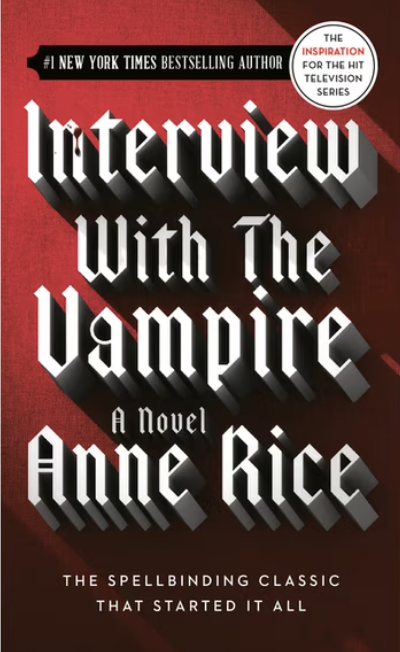
I am almost finished rereading Interview with the Vampire, and the closer I get to the end, the more I find myself reconsidering some of my earlier interpretations.
That is one of the pleasures of rereading a book like this. The novel is so layered that a single line can change meaning depending on what comes before it, what comes after it, and what the reader is prepared to notice at the time.
One thing I have been thinking about is Louis’s relationship with Claudia.
Earlier, I focused heavily on the moment when Louis describes Claudia as his child, sister, and bride. I took those words very literally, especially because the novel already contains uncomfortable moments involving children, desire, and the way adult vampires respond to youthful bodies.
However, a later conversation between Louis and Armand made me reconsider that interpretation.
When Armand refers to Claudia as Louis’s paramour, Louis corrects him. He insists that Claudia is not his lover. She is more like his child.
That distinction matters.
Perhaps when Louis describes Claudia as his child, sister, companion, and bride, he is not confessing to a literal romantic relationship. Perhaps he is attempting to explain that Claudia has occupied nearly every intimate role in his life.
She is his family.
She is his closest companion.
She is the person who understands his existence more completely than any human ever could.
She is, in many ways, his entire world.
That does not erase all the discomfort surrounding the novel’s treatment of childhood and desire. There are still moments that carry what I can only describe as predatory undertones. Armand’s history and presentation complicate the matter. Lestat’s reaction to the young boy Claudia uses to lure him also carries an unmistakable uneasiness.
Those elements are still there.
But I am no longer certain Louis belongs within that interpretation in the same way.
I may have read his language too literally when what he was actually expressing was emotional totality. Claudia does not hold one place in his life. She holds all of them.
That realization led me to another thought about Louis. One that may explain much of his constant melancholy.
Louis continues to look at vampires through the eyes of a human.
He studies Claudia’s stillness and describes her as though something is wrong. She does not fidget. She does not breathe. She can sit so motionless that she resembles a statue.
But Claudia is dead.
She has been dead for decades.
Her stillness is not unusual for what she has become. It is only disturbing when measured against the behavior of a living human child.
Louis does this repeatedly. He observes vampires, including himself, and judges their bodies, emotions, and behavior according to human expectations.
Yet their human lives are over.
Their mortal selves died when they became vampires. Whatever memories, personalities, and attachments survived that death now exist inside something fundamentally different.
They are not humans with unusual diets.
They are the dead attempting to live among the living.
Louis never seems fully able to accept that.
He sees Claudia’s childlike body and continues to interpret her according to human age, even as her mind matures across decades. He looks at other vampires and recoils when their morality does not resemble human morality. He despises the hunger that sustains him because he continues to view feeding as a living man would view murder.
He wants the vampire body without surrendering the human conscience.
And perhaps that is impossible.
This is where Louis’s depression begins to feel like more than guilt. His melancholy saturates every page because he is a being caught between two identities, refusing to release the first while despising the second.
His human self is dead, but he continues to carry it.
He drags that former self through every room, every relationship, and every kill. He evaluates his immortal existence according to values that belonged to a mortal man. Then he punishes himself whenever he fails to live according to standards his new existence may never allow him to meet.
Louis is not merely grieving the people he has lost.
He is grieving himself.
He has not accepted his own death.
That may be why he is so fascinated by stillness, corpses, statues, and bodies that no longer behave as living bodies should. Every vampire he observes becomes a reminder of what he refuses to acknowledge: he is no longer a man living an altered life.
He is a dead thing continuing to move.
That conflict also explains why he feels so separate from other vampires. They seem more willing to accept their nature, or at least less interested in measuring themselves against humanity. Lestat embraces appetite, performance, beauty, violence, and survival. Armand appears to understand immortality as its own condition, with its own rules and cruelties.
Louis cannot do that.
He remains morally, emotionally, and psychologically tethered to humanity, even though humanity is no longer tethered to him.
There is something deeply horrifying about that existence.
How does a dead person continue living among the living?
How does someone mourn their own humanity while still possessing all the memories that once made them human?
How do you form relationships when everyone around you becomes either prey, reminder, or evidence of what you have lost?
Louis’s tragedy is not simply that he became a vampire. It is that he became a vampire without ever allowing the human version of himself to die.
He exists in a state of permanent contradiction.
He is alive, but dead.
He loves, but destroys.
He longs for human connection, but can no longer participate in human life.
He judges vampires as though he is not one of them.
And he mourns the loss of his soul while continuing to search for proof that it may still be there.
That is why his narration feels so heavy. His melancholy is not a temporary emotional state. It is the natural result of an identity that cannot reconcile what it was with what it has become.
Perhaps that is one of the deepest horrors in Interview with the Vampire: transformation does not guarantee acceptance.
A person can survive the death of their old self and still spend eternity refusing to become someone new.

Leave a Reply