

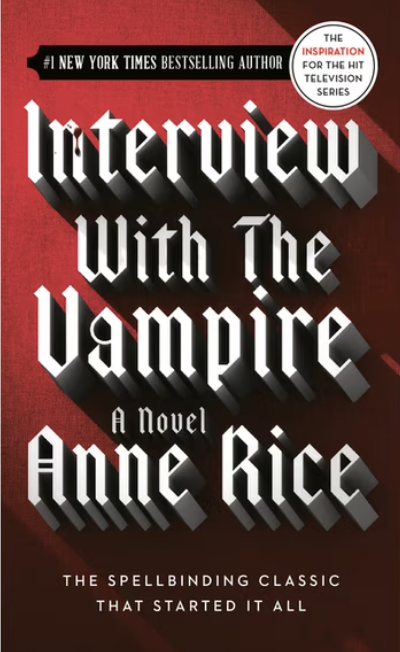
What Is Horror? Dissecting Interview with the Vampire
Horror exposes dark truths, and it often does so through monsters. But the most unsettling horror does more than ask us to fear the creature on the page. It distorts something familiar—love, parenthood, grief—until we are forced to question where devotion ends and possession begins. In Interview with the Vampire, Anne Rice uses Claudia to push love beyond its innocent boundaries and reveal the monstrosity that can emerge when grief turns another person into something we need.
I didn’t know that Anne Rice’s daughter, Michele, died of leukemia at the age of five, or that Rice’s grief found its way into Interview with the Vampire. Claudia is five when Louis and Lestat make her a vampire.
Knowing that changes the way I read her.
The love Louis and Lestat pour into Claudia is sometimes protective and overwhelming, like the kind of love a parent rains upon a child, especially after first becoming a parent. I remember those feelings. The desire to protect. The need to keep the child close. The strange terror that comes with loving someone so much that their existence becomes tangled with your own.
But the love surrounding Claudia does not remain innocent.
Louis wants her because he believes she can fill a hole inside him that not even Lestat can reach. Yet he does not want to condemn a child to the same existence they endure. Lestat, knowing what Louis desires, turns her anyway. Claudia becomes their daughter, but she is also the chain Lestat uses to keep Louis from leaving.
That is the first corruption of their love: Claudia is brought into their family not solely for who she is, but for what she can repair.
Once she is there, Louis and Lestat begin fighting over her. When Lestat first shows affection toward Claudia, Louis becomes jealous. Later, each of them occupies a different role in her life, and Claudia becomes part of the battlefield between them. One must be the bad parent. The other must be the beloved one. Parents do this in real life, too. They pull children into conflicts the children did not create and ask them, sometimes without words, to choose a side.
Eventually, Louis becomes what he wanted to be: the center of Claudia’s world.
But children grow up.
Claudia does not grow physically. She never can. Her mind, however, continues to develop inside the body of a five-year-old girl. One would imagine that causing death, and coming to understand life almost entirely through the lens of death, would force anyone to grow up quickly. We see versions of that stolen childhood in child soldiers and children pulled into gangs or other violent systems. Their bodies may still belong to children, but they have been made to carry knowledge no child should possess.
That is part of Claudia’s horror. She is denied both childhood and adulthood. She loses the innocence of one without ever being granted the freedom of the other.
She may possess the mind, desires, anger, and self-awareness of an adult, but everyone who looks at her sees a child. That contradiction complicates every relationship she has. Some adults are jealous of her forever youthfulness, or the intelligence and cunning hiding behind a child’s face. Others are drawn to her in ways that a child—or even someone trapped in the physical form of one as Claudia is—-should never have to endure.
Even the vampires’ exchange of blood becomes difficult to separate from hunger, lust, intimacy, and power. Claudia may have lived for decades, but she remains physically a child, and the novel repeatedly forces us to confront that boundary.
But that is what horror does, right?
It questions morality. It throws a mirror against the wall and leaves us staring at the fractured pieces. Then it asks: Do you see the monster within them? Do you see the monster within yourself?
The answer becomes even harder when Louis’s paternal love evolves into something resembling bridal love. This is a transformation that even he does not seem to understand. He is obsessed with Claudia. She becomes his daughter, sister, companion, and bride, all at once. Each role folds into the next until the boundaries between them become nearly impossible to identify.
The line becomes clearer, however, when Claudia begs Louis not to see Armand. Her plea contains jealousy, but it also contains self-preservation. She knows Louis is attracted to Armand, and she understands that this attraction could lead to her destruction.
It reminds me of the friction that can emerge when a single parent begins dating again. A household that once felt settled must suddenly reconsider everyone’s place within it. Who comes first? Where does the child belong now? What happens when the parent’s desire threatens the structure the child depends upon?
Except Claudia is not merely afraid of losing Louis’s attention. She is afraid that his love for someone else will cost her life.
That is what makes the love in this novel so difficult to swallow. Love is everywhere, but almost none of it is free. Louis wants Claudia to fill his emptiness. Lestat creates her to hold Louis close. Claudia clings to Louis because she loves him, but also because she needs him to survive. Their love is real, yet it is tangled with grief, jealousy, dependency, ownership, and fear.
The monsters make this entanglement easier to examine because we can initially tell ourselves that they are not human. Their hunger is not human. Their morality is not human. Their love does not have to follow human boundaries.
But then I have to stop.
What is human?
What do we call the people who possess none of the physical characteristics of fictional monsters but cause the same harm in real life? Those who call their behavior love while using another person to fill a void, settle a conflict, maintain control, or prevent abandonment?
Perhaps the monster is not defined by fangs, immortality, or the need to drink blood. Perhaps the monster appears whenever love refuses to recognize the beloved as a person separate from their own desires.
I also learned that the family at the center of the novel emerged, at least partly, from Rice’s own. Claudia was inspired by her daughter, Michele. Rice recognized herself in Louis’s grief, Catholic guilt, and brooding nature, while Lestat was inspired largely by her husband, Stan, before eventually absorbing parts of Rice herself.
That makes the conflict surrounding Claudia feel even more intimate. These are not simply two vampires fighting over a child. They can also be read as two grieving parents circling an absence neither of them knows how to survive. Claudia becomes the shape given to that absence. First through her creation, then through the battles fought over her, and finally through her death.
I can see the love in that. I can also see the grief and anger. I can see how Rice might have reached for the inconceivable—the loss of a child—and found that realism alone could not contain it.
So she gave grief fangs.
Through Claudia, love is contracted and expanded until it reaches its most terrible limits. Parental devotion becomes possession. Protection becomes control. Companionship becomes dependency. The desire to preserve a child becomes the act that prevents her from ever growing into herself.
That, to me, is the dark truth Interview with the Vampire exposes: love does not stop being dangerous simply because it is sincere. When love becomes more concerned with filling our emptiness than honoring the person we claim to love, it can become monstrous.
And horror, at its most powerful, makes us look directly at that monster, even when it is wearing a familiar face.

Leave a Reply