

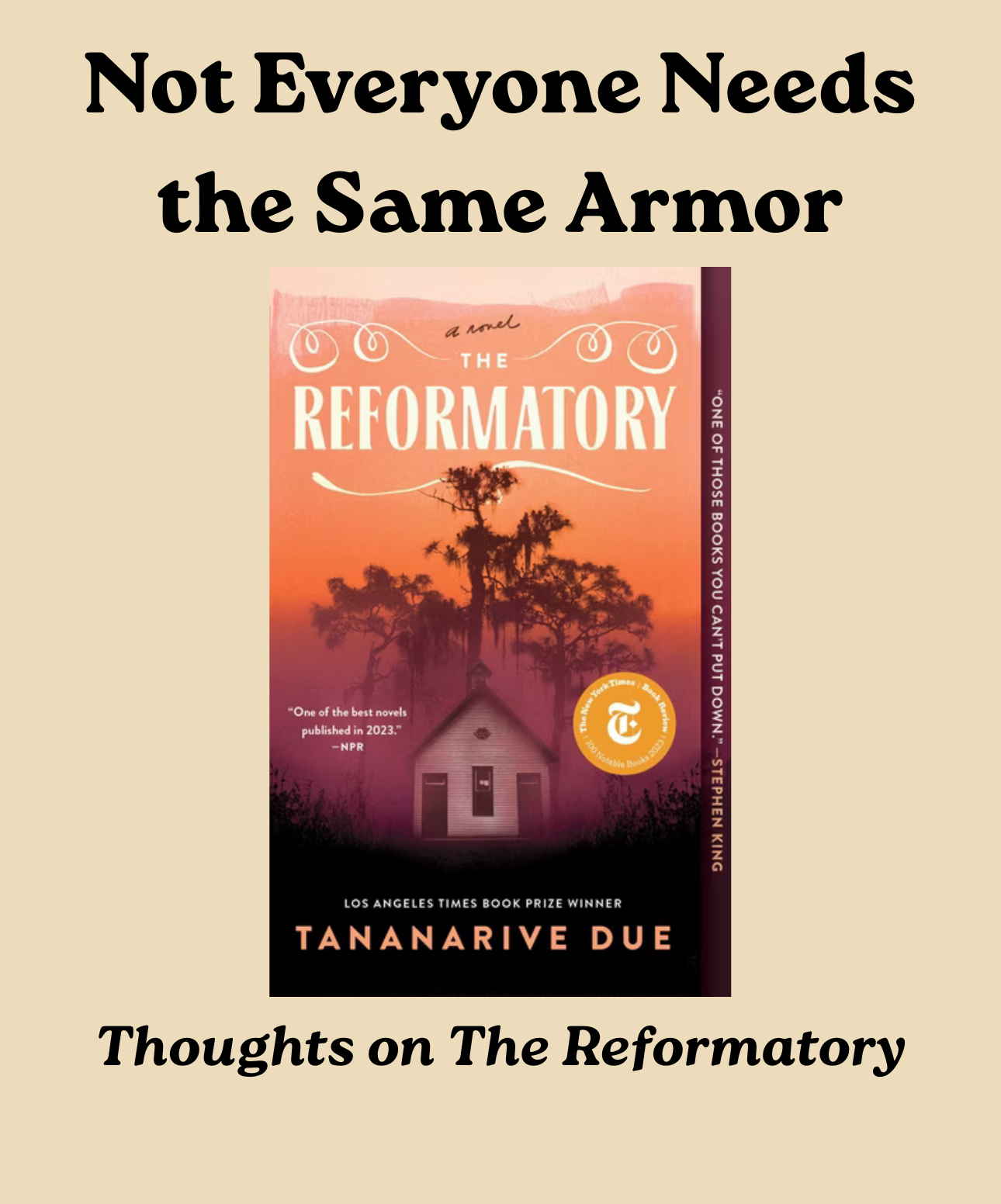
I recorded a video yesterday while listening to The Reformatory by Tananarive Due, and there was one scene I could not stop thinking about.
But first, a small digression, because apparently I am incapable of getting to the point without taking the scenic route.
I am a huge believer that we can learn from fiction.
Actually, I think that is one of fiction’s greatest powers.
When we read stories written from experiences outside our own identities, we are given an opportunity to inhabit someone else’s world for a little while. We see what they see. We experience obstacles we may never encounter ourselves. And, if we’re willing to listen, fiction can create empathy and understanding in ways that statistics and history lessons sometimes cannot.
Which brings me back to The Reformatory.
There’s a scene between Gloria and Miss Anne that gave me one of those moments where I had to stop listening and just sit with what the book was saying.
Gloria is thinking about courage and specifically about how little courage Miss Anne seems to have considering how much protection she possesses.
And I immediately thought:
Not everyone needs the same amount of armor to survive the same society.
That, to me, is one of the most powerful things The Reformatory illustrates.
A scene in The Reformatory by Tananarive Due had me thinking about privilege, courage, and how differently people experience the same systems.
The novel takes place in Jim Crow Florida in 1950, where twelve-year-old Robert Stephens Jr. is sent to a segregated reform school after defending his older sister, Gloria. Due has said herself that although the book is set in 1950, she wanted readers to recognize the lineage connecting Jim Crow to contemporary policing, incarceration, and the school-to-prison pipeline.
That connection matters because the systems in this book are historical, but the concept underneath them isn’t.
We like to imagine that everyone walks through society standing on equal ground.
We don’t.
Imagine instead that we are all required to walk through the same battlefield.
Everyone receives armor before entering.
But some people are walking through areas where almost nothing is being fired at them. Maybe they need a helmet and a light vest.
Others are walking directly into the line of fire.
They need layers.
That is how I started thinking about Gloria and Miss Anne.
Miss Anne is a queer white woman. Her queerness means she does not fit perfectly within the social expectations surrounding her. She has something to lose.
That matters.
But she is also white in a society structured around whiteness. She comes from a family with wealth and standing. Those things give her protections Gloria simply does not have.
Gloria is a young Black girl in Jim Crow Florida.
She’s Black.
She’s a girl.
She’s young.
Her mother is dead, and her father is absent because his activism has made him a target.
And now her little brother has been swallowed by a system specifically designed to exercise power over children like him.
Almost every social structure surrounding Gloria places another obstacle in front of her.
So Gloria needs stronger armor.
She has to.
Miss Anne can afford to move through the world with less of it because other things are already protecting her.
Her whiteness is armor.
Her family’s name is armor.
Money is armor.
Social standing is armor.
None of those things mean Miss Anne cannot experience prejudice or fear. Privilege does not mean a person has never suffered.
It means their suffering does not erase the protections they possess in other areas of their life.
And Gloria understands this instinctively.
That’s why her frustration with Miss Anne’s lack of courage hit me so hard.
Essentially, Gloria’s argument is: You can afford to risk more than I can.
Miss Anne has protections Gloria does not possess, and yet Gloria is the one forced to be courageous.
That distinction matters.
We often talk about courage as though everyone is standing at the same starting line.
They aren’t.
Courage costs different people different things.
Speaking against injustice might make one person uncomfortable.
It might cost another person their job.
For someone else, historically and even today, challenging the wrong institution or person can threaten their safety, their freedom, or their life.
So when someone with greater social protection refuses to act because acting might make them uncomfortable, the burden inevitably shifts toward the people who have the most to lose.
And that is what makes Gloria’s observation about Miss Anne more than just a character judgment.
It becomes a question about allyship.
What are you willing to risk when the system already protects you more than it protects the person standing beside you?
Due has talked about precisely this tension in The Reformatory. She describes Jim Crow not simply as something terrorizing Black people but as a system that also frightened potential white allies into inaction. Characters may believe they want justice, but fear limits what they are willing to risk to obtain it.
And here’s where the historical setting becomes uncomfortable.
Because we can easily read a novel about Jim Crow and congratulate ourselves for recognizing how horrific those systems were.
Of course that was wrong.
Of course segregation was wrong.
Of course the Black characters should have been treated equally.
Those answers are easy when we’re looking backward.
The harder question is what we recognize when we’re looking around.
Because while the laws have changed, disparities have not simply disappeared.
Race, gender, wealth, sexuality, disability, citizenship, class, and countless other identities still affect how easily someone can move through American institutions and what consequences they may face when something goes wrong.
The armor is still distributed unevenly.
Some people walk into a courtroom assuming the system will recognize their humanity.
Others enter knowing history has taught their families not to make that assumption.
Some parents send their children into schools primarily worried about grades.
Others also have to worry about whether their child’s behavior will be interpreted as disruptive, dangerous, or criminal.
Due has explicitly connected The Reformatory to those modern realities, particularly the disproportionate criminalization of Black and brown children and the school-to-prison pipeline.
And this is exactly why I believe reading fiction outside of our own identities matters so much.
A book cannot magically make someone empathetic.
Reading diverse books does not automatically make someone a better person.
But fiction can hand us somebody else’s armor for a few hundred pages.
It can make us feel how heavy it is.
It can show us why one character has learned to watch every word while another speaks freely.
Why one person hesitates before calling the police while someone else assumes the police will protect them.
Why one character has learned courage because courage was never optional.
I’m not finished with The Reformatory yet, so my understanding of Miss Anne may change. Maybe she will surprise me. Maybe she won’t.
But where I am right now, Gloria’s frustration with her has already given me something worth carrying beyond the book.
Equality cannot simply mean handing everyone the same armor and declaring the situation fair.
We also have to ask who is being fired upon.
Who has historically been placed in the line of fire.
Who built the battlefield in the first place.
And perhaps most importantly, if you are fortunate enough to walk through the world wearing lighter armor because the structures around you offer protection—
what are you willing to risk for the person standing beside you who doesn’t have that luxury?
Check out The Reformatory
Affiliate Disclosure: This post contains a Bookshop.org affiliate link. If you purchase The Reformatory through my link, I may earn a small commission at no additional cost to you. Your support helps me continue creating bookish content and supporting independent bookstores.

Leave a Reply