

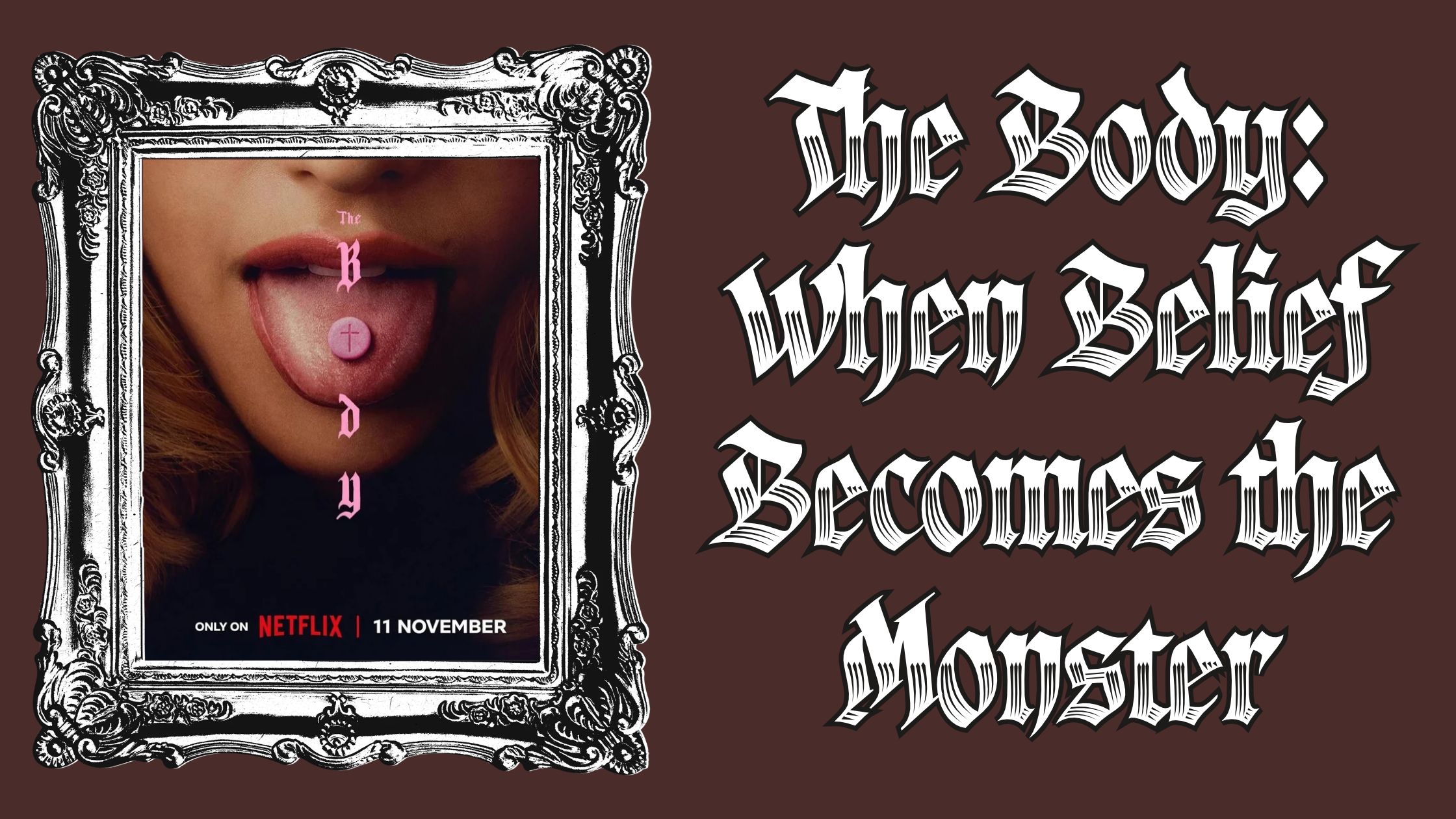
I finished watching The Body on Netflix yesterday, and let me tell you, my immediate reaction was: What the fuuuuuuuck did I just watch?!
And I mean that in the best possible way.
This show is trippy as fuck. It has everything from early 2000s mean-girl culture to religious repression, queer identity, cult behavior, and mass hysteria. And the entire time I was watching, I kept thinking about the Salem witch trials.
Yes, Salem. Because underneath all the teenage drama, Catholic guilt, and questionable decisions is a story about something that has terrified me for a long time: what happens when people become so convinced of their beliefs that they stop questioning whether those beliefs are true?
And what happens when someone learns how to manipulate those beliefs for their own benefit?
That’s where The Body becomes particularly disturbing.
Mean Girls, Catholic School, and One Terrible Secret
First, let’s talk about the premise.
The Body takes place in 2004 and follows a group of teenage girls attending a Catholic high school. They’re part of the school’s competitive dance team, and like most high school friend groups portrayed on television, there’s a hierarchy.
You have the ringleader, the unofficial second-in-command, the innocent girl, and the other members whose positions within the group depend on how well they navigate the social dynamics.
You know the type.
Everyone has a role. Everyone has something to hide. And everyone is trying to maintain their place within a social structure that can turn against them at any moment.
But here’s where things get interesting.
During an initiation party, something goes terribly wrong, and one of the girls ends up in a coma. Suddenly, this friend group, whose members were already hiding individual secrets, shares one enormous secret that could destroy everything.
And if you think that’s the worst of it, oh, no.
We’re just getting started.
Because one of the girls comes from a religious cult, and while she may have physically escaped that environment, she hasn’t necessarily escaped everything she learned there.
That distinction matters.
And it’s one of the most fascinating aspects of the show.
When You Leave a Cult, but the Cult Doesn’t Leave You
Something I found particularly compelling about The Body is how it explores the lasting influence of religious indoctrination.
We often talk about escaping cults as if leaving the physical environment automatically means someone has freed themselves psychologically.
But what happens when the behaviors, beliefs, and methods of manipulation learned within that environment become part of how someone understands the world?
What happens when those behaviors become tools for survival?
In The Body, we see how someone familiar with religious manipulation can recognize the vulnerabilities of a community already conditioned to believe in supernatural intervention, divine punishment, and miracles.
And here’s the thing: I don’t think the most terrifying aspect of this character is simply that she knows how to manipulate people.
It’s that she understands exactly what they need to believe.
That is an entirely different level of power.
She doesn’t have to create people’s fears or desires. Those already exist. She only has to give them a story that makes sense within their religious worldview.
And once enough people accept that story, questioning it becomes increasingly difficult.
Because now you’re not simply questioning an event.
You’re questioning someone’s faith.
The Salem Witch Trials All Over Again
This is where my brain kept returning to Salem.
I recently visited Salem, Massachusetts, and one of the things that fascinates me about the witch trials of 1692 is how quickly accusations, fear, and religious conviction became intertwined.
People were accused of witchcraft based on claims of supernatural experiences. The afflicted claimed to see things others couldn’t see. Those claims were treated as evidence, and questioning their legitimacy could place someone under suspicion.
The result was devastating.
Nineteen people were hanged, one man was pressed to death, and others died while imprisoned.
Now, obviously, The Body isn’t a historical retelling of the Salem witch trials. But the psychological mechanisms at work felt disturbingly familiar.
In the show, a girl lies in a coma while the community begins attributing supernatural significance to her condition. Miracles are discussed. Visions are reported. The girls become increasingly entangled in an atmosphere where religious interpretation begins replacing reasonable questioning.
And suddenly, the question isn’t necessarily what happened to this girl.
It’s what people believe happened to her.
See the difference?
Because those are two very different things.
One asks for evidence.
The other asks for faith.
And when a community decides that faith is the only acceptable response, the people who question the narrative may find themselves isolated, discredited, or accused of something far worse.
That’s what makes mass hysteria so frightening to me.
It doesn’t require everyone to be deliberately dishonest. Some people may genuinely believe what they’re experiencing. Others may be afraid to contradict the group. And some may recognize an opportunity to gain influence.
All those motivations can exist simultaneously.
And in The Body, the audience is left navigating those competing possibilities right alongside the characters.
Is It a Miracle, a Manipulation, or Something Else?
One of my favorite aspects of psychological horror is when a story makes me question my own interpretation of events.
I love that moment when I think I’ve figured something out, only for the narrative to introduce another possibility that makes me reconsider everything.
The Body does that remarkably well.
Because while the show gives us reasons to suspect manipulation, it also presents experiences that aren’t so easily explained away.
Are these girls genuinely experiencing something supernatural?
Are they responding to collective guilt and psychological distress?
Are their visions being shaped by religious expectations?
Or is someone intentionally exploiting an already fragile situation?
The show understands that uncertainty can be far more unsettling than an outright supernatural revelation.
And what makes it even more effective is that the characters themselves don’t necessarily know what to believe.
We’re watching people who have been taught to interpret the world through a particular religious framework struggle to understand experiences that appear to confirm their deepest convictions.
But believing something happened doesn’t necessarily mean understanding why it happened.
And that distinction becomes increasingly important as the story progresses.
The most frightening thing about the supernatural isn’t always the possibility that it exists. Sometimes it’s what people are willing to do because they believe it exists.
Religious Repression and the Queer Experience
Now, we cannot talk about The Body without addressing its commentary on sexuality, particularly queer identity within conservative religious environments.
Because this is another layer that makes the show so interesting.
We’re transported back to the early 2000s, when the culture surrounding sexuality, especially queer sexuality, was vastly different from the conversations we’re having today.
And while we’ve made progress, let’s not pretend that religious repression and the shame surrounding queer identities have disappeared.
For these girls, desire isn’t simply something to explore or understand. It’s something that can carry moral consequences.
There is a constant tension between what they want, what they’ve been taught to believe, and what their community expects from them.
And that tension creates fertile ground for guilt.
When someone has been taught that certain desires are sinful, even ordinary experiences of attraction can become sources of fear and self-loathing.
Now imagine navigating that while also dealing with the emotional volatility of adolescence, friendship hierarchies, and the possibility that God is personally judging your every thought.
It’s a recipe for psychological turmoil.
What I appreciate about the show is how it places those struggles alongside the larger religious hysteria.
The girls are trying to make sense of their desires while simultaneously trying to interpret events they believe may be supernatural.
And in both situations, they are struggling with the same fundamental question:
Can I trust what I feel when I’ve been taught that what I feel might be wrong?
That’s a powerful question.
And it’s one that extends well beyond the fictional walls of this Catholic high school.
The Horror of Belonging
Something else I kept thinking about while watching was how much of this story revolves around belonging.
Because at its core, The Body is also about teenage girls desperate to be accepted.
The dance team provides status, friendship, identity, and a sense of importance within the school.
But belonging comes with conditions.
There are expectations to fulfill, secrets to protect, and unspoken rules about who gets to lead and who must follow.
And here’s where the parallels between the friend group and religious manipulation become especially interesting.
Both operate through systems of acceptance and exclusion.
Both establish rules for behavior.
Both can punish those who step outside their expectations.
And both can make someone feel that losing their place within the group would mean losing a fundamental part of themselves.
Of course, I’m not suggesting that every teenage friend group operates like a cult.
But I do think The Body intentionally explores how the desire to belong can make people vulnerable to manipulation.
Because when acceptance becomes more important than individual judgment, people can find themselves participating in things they would otherwise question.
And the more invested they become, the harder it is to walk away.
Especially when everyone is hiding something.
Why This Feels Like Religious Horror Without Needing a Monster
As someone who loves horror, particularly stories that examine the darker aspects of human behavior, I found this approach fascinating.
Religious horror often gives us demons, possessions, exorcisms, or supernatural entities threatening the faithful.
And don’t get me wrong. I enjoy those stories.
But The Body explores something that can be just as terrifying: the power human beings give to religious interpretations, especially when fear and guilt are involved.
The horror isn’t limited to whether something supernatural is happening.
It’s also in how quickly people surrender their judgment to an explanation that confirms what they already believe.
And how dangerous that explanation becomes when someone learns to control it.
That is why the Salem parallels resonated with me so strongly.
The tragedy of Salem wasn’t that people believed in witches.
It was that those beliefs became justification for persecution, punishment, and death.
The possibility of being wrong was overshadowed by the conviction of being righteous.
And while The Body presents these themes through teenage drama, dark humor, and psychological horror, the underlying questions are anything but trivial.
Who gets to decide what is sacred?
Who benefits when a community believes a miracle has occurred?
Who is believed, who is silenced, and who gets to control the narrative?
And perhaps most importantly, what happens to the truth when everyone has something to gain from believing a lie?
Final Thoughts: What the Fuck Did I Just Watch?
I finished The Body with more questions than answers, and I think that’s precisely why it worked for me.
The show is messy, uncomfortable, provocative, and at times downright absurd.
But underneath the early-2000s nostalgia, teenage cruelty, religious symbolism, and sexual repression is a story that asks us to examine how easily belief can become a weapon.
And how quickly a community can transform uncertainty into conviction.
What I enjoyed most wasn’t necessarily trying to determine whether the supernatural events were real.
It was watching how the characters responded to the possibility that they were.
Because their reactions revealed far more about them than any miracle could.
Their fears, desires, shame, jealousy, and desperate need for belonging shaped the way they understood everything happening around them.
And that’s something I find particularly compelling about psychological horror.
Sometimes the monster isn’t the thing lurking in the shadows.
Sometimes it’s the certainty that we’re right.
So, would I recommend The Body?
Absolutely.
Especially if you enjoy psychological horror, religious commentary, morally complicated characters, queer coming-of-age narratives, and stories that refuse to give you easy answers.
And if you love the unsettling atmosphere of The Crucible, the social cruelty of Mean Girls, and the religious dread of Carrie, you might find something here worth exploring.
Just don’t expect the show to hold your hand.
Because by the time those final credits roll, you might find yourself staring at your television and asking the same question I did.
What the actual fuck did I just watch?
And I mean that as a compliment.
Have you watched The Body on Netflix? I would love to know what you thought about its religious commentary, the mass hysteria, and the way it explores sexuality and belief. Did you get the Salem witch trials vibes, too? Let’s talk about it in the comments. Just be mindful of spoilers for readers who haven’t finished the series!

Leave a Reply