

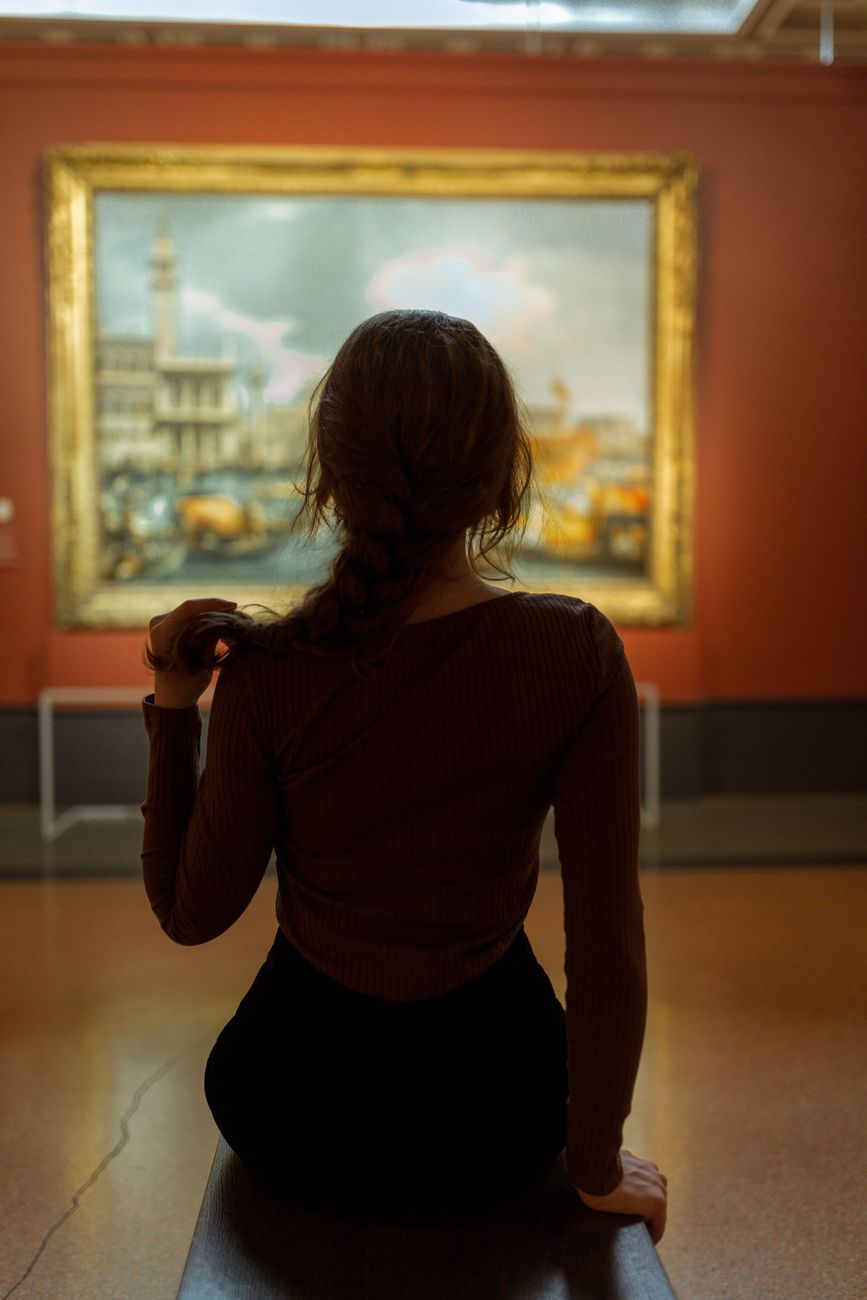
Yesterday, I walked into an exhibit at The Huntington and something inside of me broke open.
I wasn’t expecting it.
I had gone to The Huntington as the first stop on my bookish birthday adventure. The plan was books, art, gardens, indie bookstores, good food. You know? All the things that make me happy.
And then I walked into Laura Aguilar: Body and Landscape.
I didn’t know how deeply those photographs were going to affect me.
But they did.
A Body That Wasn’t Hiding
Laura Aguilar was a Chicana lesbian photographer who frequently placed herself in front of her own camera. Her work explored her queer identity, her body, the people within her LGBTQ and Latino communities, and her relationship with the landscapes of Southern California and the Southwest.
The Huntington describes her photography as using the landscape as a place for visibility, personal power, resilience, and reclamation.
That sounds beautiful when you read it in a museum description.
Standing in front of the photographs felt different.
There she was.
A queer woman.
A large-bodied woman.
Naked.
Visible.
And completely unapologetic about being seen.
That was what hit me first.
She wasn’t hiding her stomach.
She wasn’t twisting herself into some carefully calculated pose designed to make her body appear smaller.
She wasn’t sucking anything in.
She wasn’t waiting until she became some other version of herself before allowing the camera to capture her.
She was simply there.
And she was beautiful.
Not beautiful despite her body.
Beautiful in it.
When the Body Became the Landscape
Then I began looking at the photographs Aguilar took outdoors.
And this is where something shifted for me.
In several images, Aguilar positioned her nude body among rocks, earth, and open landscapes. The shapes began speaking to one another.
The curve of her body.
The curve of a rock.
The folds of skin.
The folds of the land.
Her body didn’t look separate from the landscape surrounding her.
It looked like it belonged there.
I remember staring at one of those photographs and thinking:
Isn’t that beautiful?
Her body was like the land around her.
And the more I looked, the more obvious it seemed.
Of course it was.
Our bodies are nature too.
We talk about the beauty of rolling hills, curves in mountains, soft valleys, weathered stones, cracks in the earth, trees bent into strange shapes by years of wind.
Nobody looks at a mountain and asks why it doesn’t have a flat stomach.
Nobody tells a boulder its curves are in the wrong places.
We don’t demand symmetry from landscapes before we’re willing to call them breathtaking.
We accept the land exactly as it exists and call its irregularities beautiful.
And there was Aguilar putting her body beside it as if to ask why we don’t extend that same generosity to ourselves.
I stood there in awe of her.
In Sandy’s Room
And then I saw the photograph with the fan.
I didn’t know its name at the time.
I know now that it is In Sandy’s Room, photographed in 1989, and it became a pivotal work in Aguilar’s career.
The story behind the photograph makes me love it even more.
Aguilar was housesitting for her friend Sandy and looking through glamour magazines filled with idealized images of women’s bodies. She decided to photograph herself in response. In the resulting image, she sits nude in a chair near an open window while an electric fan blows toward her.
No elaborate set.
No attempt to become one of the women in those magazines.
Just Laura.
The Huntington notes that the photograph became an important turning point that eventually led Aguilar toward creating her nude self-portraits in nature.
But I didn’t know any of that when I first saw it.
I only knew how it made me feel.
Free.
She looked so fucking free.
Maybe somebody else could look at the same photograph and see something completely different.
That’s art.
But when I looked at her sitting there with that fan blowing toward her body, I saw someone who wasn’t apologizing for occupying the space she occupied.
And a tiny voice inside me asked:
Why can’t that be me?
Why Can’t That Be Me?
That question caught me off guard.
Because I wasn’t really asking why I couldn’t take that photograph.
I was asking something much bigger.
Why can’t I feel that comfortable in my own body?
Why can’t I stop worrying about how I look from this angle or that angle?
Why can’t I exist without constantly negotiating with myself about whether I am allowed to feel beautiful today?
Why can’t I look at my own body with the same tenderness I was extending to hers?
Why can’t I take up space without wondering whether I should make myself smaller first?
Why can’t that be me?
I kept walking.
And there were more photographs.
More bodies.
More women.
Bodies being presented as bodies, not problems waiting to be corrected.
Bodies worthy of photographs.
Bodies worthy of attention.
Bodies worthy of art.
And suddenly I was crying.
Not sobbing.
It wasn’t like that.
My eyes simply filled, and I felt that familiar tightening in my throat that happens when something reaches a place inside you that you didn’t realize was waiting to be touched.
I pulled out my phone and took a video.
I needed to remember that room.
I needed to remember the feeling.
And almost immediately, I made a mental note:
I have to write about this.
Because something was happening.
That Can Be Me
Then the answer came.
Quietly.
Why can’t that be me?
became
That can be me.
And whew.
There it was.
Maybe that’s why I started crying.
There is an enormous difference between those two thoughts.
Why can’t that be me? assumes there is a barrier.
Something separating her freedom from mine.
Her confidence from mine.
Her body from mine.
Her right to exist visibly from mine.
But that can be me removes the barrier.
Not when I change something.
Not when I lose something.
Not when I gain something.
Not when I finally become disciplined enough, thin enough, confident enough, young enough, polished enough, or whatever other condition we attach to the right to fully inhabit ourselves.
Now.
That can be me now.
I can take the picture.
I can wear the thing.
I can stand in front of the camera instead of automatically volunteering to be the person behind it.
I can exist in my body without treating it like something that must constantly be improved before it deserves affection.
I can let myself be seen.
The Radical Act of Occupying the Frame
The more I have thought about Aguilar’s work since leaving the museum, the more I think visibility is at the center of what moved me.
Because Aguilar didn’t simply photograph bodies that traditional ideas of beauty often exclude.
She placed those bodies in the center of the frame.
That distinction matters.
The Huntington describes Aguilar as someone whose identity as a large-bodied Chicana lesbian informed a body of work that challenged the kinds of beauty and identity historically pushed to the margins of mainstream art.
She didn’t remain at the margins.
She made the photograph.
She controlled the lens.
She chose the frame.
And then she stepped inside it.
There is power in that.
Especially when you belong to communities that have historically been told, in a thousand different ways, when and how they may be visible.
You can be visible, but not too loud.
Proud, but not too proud.
Different, but not so different that anyone becomes uncomfortable.
Sexy, but only if your body meets certain requirements.
Confident, but only if society has already decided you have something worth being confident about.
Take up space, but please make sure it isn’t too much.
Aguilar’s photographs reject that bargain.
Her body takes up exactly as much space as it takes up.
And the photograph adjusts around her.
Not the other way around.
I think that was the part that took my breath away.
Maybe I Don’t Need Permission
It feels especially significant that I encountered this work during my birthday month.
Another year.
Another orbit around the sun.
And maybe another opportunity to interrogate some of the rules I have unconsciously carried with me.
Rules about bodies.
Rules about beauty.
Rules about visibility.
Rules about whether I have earned the right to occupy the frame.
I don’t know that one museum exhibit can undo years of learning how to scrutinize yourself.
Probably not.
But sometimes art doesn’t need to completely heal something.
Sometimes art just needs to create the crack.
A little opening where a different thought can get through.
Laura Aguilar gave me that.
I walked into that gallery admiring a woman who seemed unapologetic about being photographed in her own body.
I stood there thinking:
Why can’t that be me?
And I walked out thinking:
That can be me.
Maybe one day I’ll stand in front of a camera and feel that free.
Maybe I won’t need to analyze every angle.
Maybe I won’t immediately look for what needs to be cropped, hidden, edited, sucked in, smoothed out, or corrected.
Maybe I’ll simply look at the woman in the photograph and think:
There she is.
And maybe that is enough.
Actually, maybe it always was.

Leave a Reply