

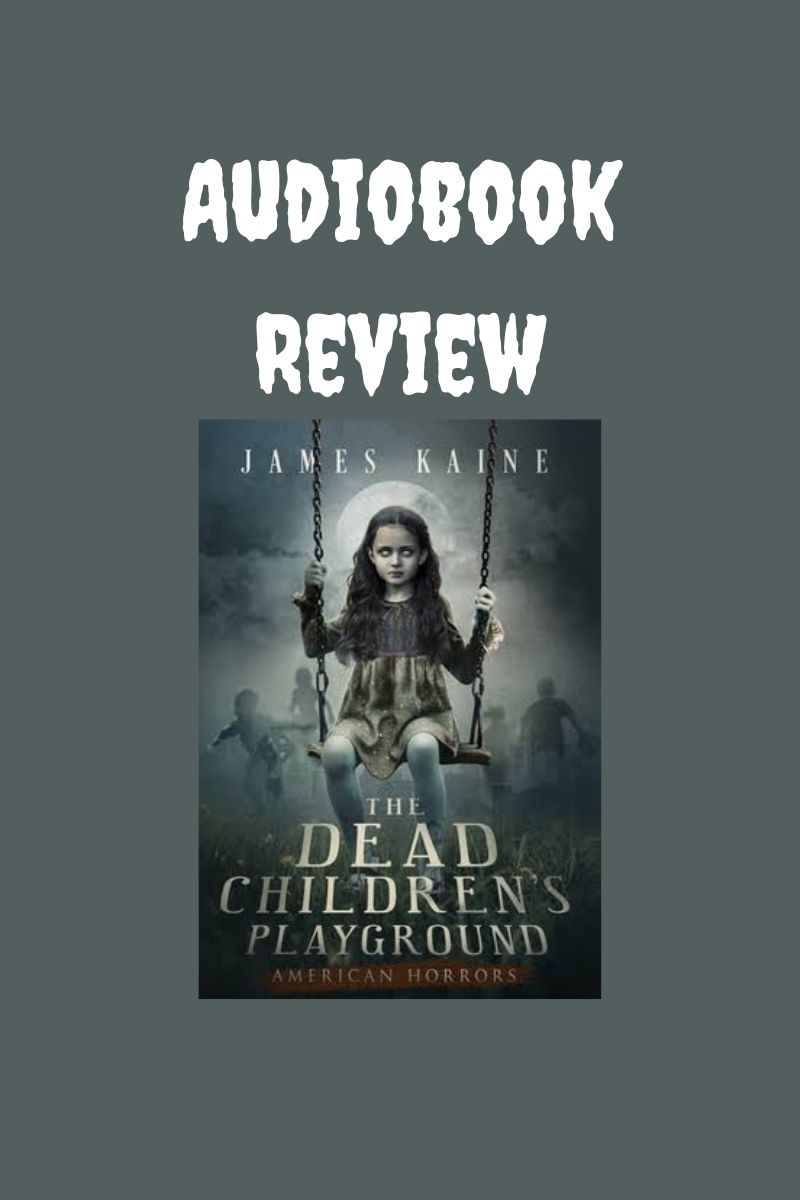
I recently listened to The Dead Children’s Playground by James Kaine, the first book in his American Horrors series, and I have to say, this story brought something fresh to the small-town ghost story. I love when horror takes a familiar setup, like a haunted playground near a cemetery, and then twists it into something deeper, stranger, and more emotionally complicated than expected.
This one follows two sisters, nine-year-old Kylie Macklin and nineteen-year-old Kayla Macklin, after their family moves to Huntsville for a fresh start. Kylie has survived cancer and is trying to reclaim a childhood that illness interrupted. Kayla, on the other hand, is carrying a lot of resentment. Her life has been uprooted, her family dynamic has long revolved around her little sister’s health, and she is trying to figure out where she fits now that everyone is supposed to move forward.
Then there is Maple Hill Park, a playground sitting at the edge of Maple Hill Cemetery, where the spirits of dead children gather. Some died during the Spanish Flu. Others were victims of something much more sinister. What begins as a ghostly mystery becomes a race against time as children in Huntsville start collapsing with devastating fevers and a long-dead killer seems to return.
That premise alone is strong. A cemetery playground for child spirits? A history of illness, murder, and unresolved trauma? A town still carrying old scars? Yes. That is exactly the kind of horror setup that makes me lean in.
I gave this book a solid 3.5 out of 5 stars.
And honestly, I think that rating fits how I felt. I enjoyed it. I was entertained. I thought the story had some really interesting ideas. But a few things pulled me out enough that I could not push it higher.
One of the biggest issues for me was Kylie’s internal monologue. She is nine years old, but there were moments where her thoughts skewed much older. Not just mature because she had survived illness, which would make sense, but more like an adult processing the world through a child’s body. That made it harder for me to fully believe her voice at times.
Also, because I listened to the audiobook, I kept getting Kylie and Kayla confused. And listen, that happens in real life too. People have similar names. Families do that all the time. But in audio format, with the two sisters having such similar names and with Kylie sometimes thinking in a way that felt older, it blurred the line between them for me. I had to pause and reorient myself more than once.
The other thing that gave me real pause was a line about “modern sensitivities” in relation to how one character described a Black woman. For me, that phrasing felt dismissive of the actual harm behind that kind of language. The issue is not simply that language has changed over time or that people today are more sensitive. The issue is that certain words and classifications were used to dehumanize people, reinforce white superiority, and create a culture and legal system built around that hierarchy.
I think there could have been a more nuanced way to handle that moment. Something like acknowledging that the ghost had not lived long enough to learn better would have landed differently. That would still make room for historical context without implying that the harm exists only because of modern discomfort. Because the truth is, those words were harmful when they were used. They helped create harm. They were not neutral terms that later became inconvenient.
And I get that not every author will have the lived experience or proximity to understand that nuance in the same way. But as a reader, especially one who pays close attention to how history, identity, and power show up in fiction, that line stood out to me.
Now, putting those critiques aside, there was a lot I genuinely liked about this book.
The family dynamics were probably my favorite part. James Kaine does a really strong job showing how illness can reshape an entire family. When a child is sick, everything tilts toward survival. The parents’ attention, resources, worry, time, energy, all of it goes toward the child who needs care. And that makes sense. Of course it does. But that does not mean the other children in the family come out untouched.
Kayla’s resentment felt realistic to me. Not pretty, but real. That is what made it compelling. She loves her sister, but she has also been living in the shadow of Kylie’s illness for years. That kind of emotional contradiction is messy, and I love when fiction lets characters be messy without immediately punishing them for it. Kayla is not just the bitter older sister. She is a young woman trying to rebuild a bond while also carrying the ache of being overlooked.
That emotional tension gave the horror more weight. Because yes, there are ghosts. Yes, there is danger. Yes, there is a demonic presence haunting dead children. But underneath all of that, there is a family trying to figure out how to be whole after years of fear.
That is the kind of horror I tend to love most. Horror that is scary, but also tender. Horror that understands the monster is not always separate from grief, resentment, guilt, or love. Sometimes the haunting works because the emotional foundation is already cracked.
I also really liked the backstory of the children in the playground. The mix of history and fiction made the story feel grounded, even when the supernatural elements got big. The Spanish Flu connection gave the haunting a historical weight, and the serial killer element added that extra layer of danger. The playground was not just spooky because dead children were there. It was spooky because it felt like a place where innocence had been interrupted over and over again.
The incorporation of Catholic faith rituals and hoodoo elements was interesting too. I always appreciate when horror allows spiritual traditions to have texture and purpose. Those elements helped expand the story beyond the typical haunted small town formula. It gave the world a sense of belief, ritual, and cultural memory, which made the supernatural conflict feel more layered.
And I have to give the book credit for atmosphere. A playground at the edge of a cemetery already feels unsettling, but this story uses that image well. There is something deeply eerie about a place built for children’s joy becoming a gathering place for children who never got to grow up. That image stays with you.
For me, The Dead Children’s Playground works best when it leans into that duality. Childhood and death. Play and grief. Family love and family resentment. Faith and fear. History and haunting. Those contrasts are where the book feels strongest.
So while this was not a perfect read for me, it was still a memorable one. It brought a fresh twist to small-town ghost stories, and I respect that. I would rather read a horror novel that takes risks and gives me a lot to think about than one that plays everything safe.
If you enjoy ghost stories with emotional family drama, historical horror, haunted places, and a tender but chilling atmosphere, this one may be worth adding to your list. Just know that some character voice choices and certain phrasing around race may land differently depending on the reader.
For me, The Dead Children’s Playground was eerie, heartfelt, and original enough to keep me invested, even when a few things pulled me out.
If you want to check out the book, go to the author’s website here

Leave a Reply